


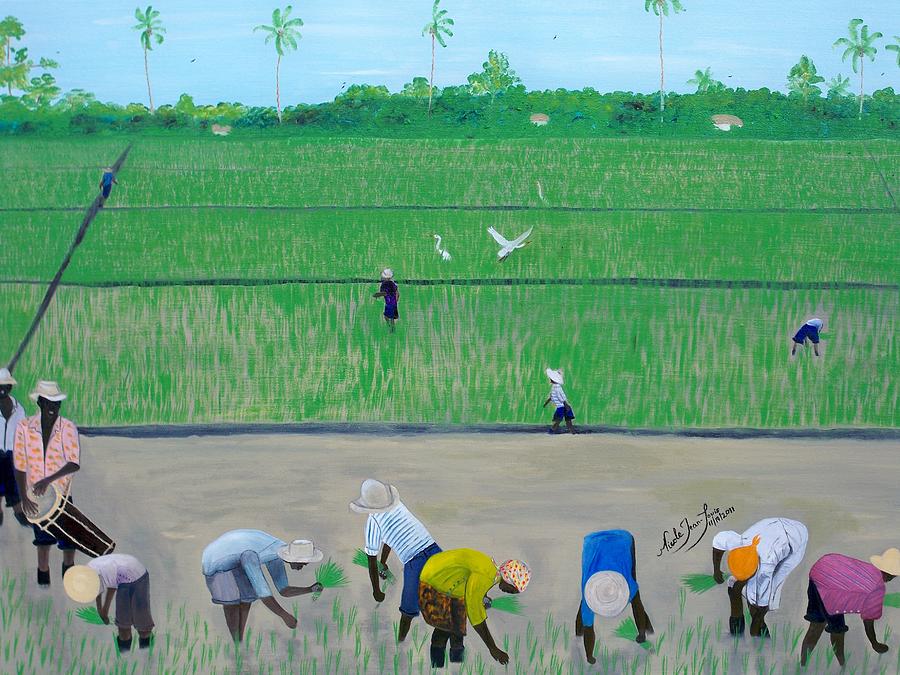
Rice Field Haiti 1980 is a painting by Nicole Jean-Louis which was uploaded on November 26th, 2011.
Rice Field Haiti 1980
My painting depicts Haitian peasants planting rice in 1980. This region is called Vallee de L'Artibonite, in Creole, Latibonit. This region bears its... more



Buy the Original Painting
Price
Not Specified
Dimensions
40.000 x 30.000 x 0.900 inches
This original painting is currently for sale. At the present time, originals are not offered for sale through the Fine Art America secure checkout system. Please contact the artist directly to inquire about purchasing this original.
Click here to contact the artist.
Title
Rice Field Haiti 1980
Artist
Nicole Jean-Louis
Medium
Painting - Oil On Canvas
Description
My painting depicts Haitian peasants planting rice in 1980. This region is called "Vallee de L'Artibonite", in Creole, "Latibonit". This region bears its name from the homonymous long river which crosses the land. L'Artibonite is the largest of the 10 departments of Haiti, (departments are administrative divisions). This is an enclave rich in agriculture, with its own irrigation systems, including canals and drainage which reduce the flooding during the rainy season. This is the country's main rice growing area. Rice is Haiti's staple food. Agriculture plays an important role in revenue, employment, and exportation for Haiti. Rice land is economically important as well as ecologically valuable; one can feel the refreshing coolness of rice fields as opposed to the oppressive heat in the asphalt or dirt road of the city or suburbs; insects in rice fields, and frogs are food for the egrets seen in my painting.
The mountain rice farmers feed their family and sell the surplus to the marketplace.
Haitian mountains and swamp rice is of West African origin. It has been cultivated in Haiti for over 2 centuries. Haitian's original and natural rice was produced in large quantity, 210,000 metric tons annually up to 1980's.
Why is it that since 2002, Haiti's considered one of the poorest countries in the world? What is the explanation for Haiti's stagnated income, economic ruin, shattered domestic agricultural sector, famine, poor health condition, lack of educational system, and infrastructural condition? What makes Haiti from being poor but self-sufficient, to being poor and starving?
I hope my documentary-narrative-painting will somehow help clarify this shady matter. Everything is general information available to the public and can be verified.
In the 1950's to 1970's, Haiti was neither significantly better nor worse off than most countries in the Caribbean and Latin America. Today, mention made of Haiti triggers negative images such as: poverty, starvation, overcrowding, rubbish, trash, pollution, socio-political insecurity. Likewise many other countries, Haiti has problems. The majority of Haitian peasants are agricultural laborers with high illiteracy rates. Haiti is overpopulated. The situation is within range of other Caribbean countries. However, Conservationists, Lobbyists for US agro businesses, textile industries, and the US Congress all have interests in Haiti because of Haiti's proximity to the United States, and cheap labor where workers earn less than $2.00 US a day.
The United States Agency for International Development (USAID) is the federal agency primarily responsible for administering civilian foreign aid. The USAID was created by John F. Kennedy in 1961. President Kennedy believed that low-income nations could achieve self-sustaining socioeconomic development if they improved management of their own resources. It is an independent federal agency receiving guidance from the US Secretary of State. Other non governmental organizations (NGO's) also participate in these efforts. This agency help people overseas struggling to make a better life, recover from a disaster. USAID's headquarters in Washington, DC, is organized into "Bureaus" covering specific geographical areas. Haiti, for example, belongs in the LAC (Latin American and Caribbean) bureau.
USAID had many controversies and criticism. Foreign aid is used as political weapon. Whenever Haiti asks for help, there are always some conditions imposed, some strings attached. Foreign aid is used as political weapon for the US to coerce Haiti in achieving their agenda. There is an American plan consisting of two parts designed for Haiti: the first part is the destruction of the Haitian farm economy, the second part of the plan is jobs creation: the sweatshops. This American plan started to be in full effect as early as 1971.
From 1957-1971 under President Francois Duvalier, the market national was protected. Only the port in the Capital, Port-au-Prince was opened. Importation was strictly controlled. International help, foreign aid, and loans were very feeble.
In 1971, in order to assure the continuation of the Duvalier dictatorship, from father to son, the Haitian government agreed to create an environment hospitable to US investors in the assembly sector; conditions imposed: custom taxes were eliminated, low minimum wage were guaranteed, labor unions were suppressed, and US companies were given the right to repatriate profits. There were 200 mostly US owned assembly plants in the country. There were sweatshop jobs like Disney, where those adorable Pocahontas pajamas and Aladdin t-shirts were stitched for 28 cents an hour. Sweatshop jobs like Levi, where Haitians made T-shirts, bras, and underwear for US clothing (ex.) Giants, Dockers, and Nautica; workers got paid 31cents an hour; and sweatshop jobs like Nike, where cleats, football, jog pants, and jackets, were made; workers got paid 30 cents an hour. Haiti had one of the largest assembly sectors in the developing world. The number of workers estimated as high as 80,000-100,000; had no viable pension plans, no health care, no disability pension, and no unemployment insurance benefits.
The International Monetary Fund (IMF) is the organization of 187 countries working to foster global monetary corporation, secure financial stability, facilitate international trade, promote economic growth, employment, and reduce poverty around the world. The IMF was led by USAID in adopting policies that would destroy the Haitian economy of small farmers. The US has by far the largest voice in decisions of the IMF.
In 1986, Baby Doc Duvalier escaped the country after raiding the Haitian Treasury. He fled to France with an estimated 120 Millions US dollars. In need of fund, Haiti addresses itself to the IMF. In order to be qualified for the fund, Haiti was required to adopt a Trade Liberalization Policies: Haiti's import tariff protection had to be reduced; Haiti had to decrease its tariffs on rice imports and other agricultural product. Also some industries must reduce their tariffs to open up the country's markets to competition from outside countries. Currently, the rice import tariff is 3%, compared to the original 35%. This tariff is much lower than rice import tariffs of all the other nations in the Caribbean Community.
Also part of the American plan is the privatization of State assets.
In 1987, after Baby Doc Duvalier fled the country, General Henry Namphy became president of Haiti's interim ruling body, the National Council of Government. The state's sugar mill was privatized. A single elite family (Mevs) bought it, quickly closed it, and laid off its employees. It was a profitable mill, and it provided jobs and locally produced sugar. By 1988, sugar export dropped to zero. Haiti's main exporter partners were the United States and France. By 1995, (Haiti once counted among the greatest sugar producers in the world), was importing 25,000 tons of sugar from US, Dominican Republic, and Florida per year.
In 1994, under President Jean Bertrand Aristide, and under President Bill Clinton (1993-2001), in exchange for $770,000,000 in promised aid and loans, the list of concessions appeared. It was very distressful for Aristide, who resisted at first, seeing what happened to the sugar mill. The list goes as followed:
. Tariffs were to be drastically reduced.
. Wages were to be frozen.
. Around 1/2 of the civil service were to be laid off.
. All 9 of Haiti's remaining public utilities were to be sold off:1.Telephone
2.electricity
3. port
4. airport
5. cement
6. flour
7. cooking oil plant
8. 2 states banks
Since Haiti was able to feed itself, which made it a self sufficient country, USAID justified their action by funding report that Haiti was at risk of massive malnutrition; Haitian farmers could not feed the nation. It was decided that it was unnecessary for Haitian farmers to produce food or adopt better techniques, but rather import food from the US and Western Europe. To get the process started, they began selling the US rice below market prices, and giving it away with the help of the NGO. Is the NGO aware of their contribution to that operation? USAID used the NGO as vehicles to enact their act of destruction; destruction of Haitian farming. The NGO were used because they are conveyed as humanitarian aid workers. The USAID will not confront any critics.
The NGO was given food with the condition that they will sell it on the Haitian market. Multinational charitable corporations working in the country also received grants in the form of food. The Germans and French were interested in the assembly sector gave food to the NGO's for their respective countries with the stipulation that the food be monetized in Haiti.
By 1990, the Haitian market was flooded with US rice import called "Miami rice". It is called "Miami Rice" because it is being shipped from the major port in Miami, Florida. It was impossible for Haitian farmers to compete with cheap US subsidized rice which was being, literally, dumped in Haiti. The rice was being dumped because 6 pounds of Haitian rice from L'Artibonite costs $5.26, while 6 lbs of the rice from USA cost $4.00. Unfortunately, with US rice overcrowding the domestic market, many farmers lost their businesses. Currently, one can see a former rice field being used by young soccer boy players. Some even build huts on them. Unemployed Haitians would move to Port-au-Prince, competing for the sweatshop jobs. They build their houses anywhere; in the ravines, on the side of the mountains, near the seas. This contributes to the production of trash anywhere, consequentially, contributing to the maritime and atmospheric pollution. One could understand why so many people, 316,000, lost their lives in the January 2010 Earthquake in Port-au-Prince; 300,000 were injured and 1.5million people sheltered under tents. Social insecurity also came from people being so poor. Unemployed Haitians moved to the Dominican Republic. Other Haitians moved to the Caribbean Islands, (ex.) Bahamas.
US protect its rice farmers. Rice is a heavily subsidized business in the US, while Haitian farmers do not have this allocation. According to the 2011 Farm Subsidized Database, one US producer alone, the Riceland Foods Inc of Stuttgart, Arkansas is at the top of the recipients receiving over 544 million dollars in rice subsidies between 1995 and 2010 from federal government. Riceland food is one of the top companies in Arkansas. It is one of the largest suppliers of rice for food industry in the US. It is a major rice importer to foreign countries, like Haiti. Haiti is definitely economically "poor". Yet, Haiti has become the third largest importer of rice from the US; 360,000 metric tones of rice costing $270,000,000 US dollars. With the rising energy costs, the once "cheap" rice became unaffordable. That had led to hunger riots. One may have the NGO's donated raw rice and have no money to buy oil or charcoal to cook that rice.
In 1992, President Bill Clinton signed into law the North American Free Trade Agreement, NAFTA. By eliminating tariff, exporters can increase their profits; this will afford buyers considerable saving. This Agreement will remove most barriers to trade and investment among the US, Canada, and Mexico. On August 5, 2004, the United States, Dominican Republic, and Central American countries of Costa Rica, El Salvador, Guatemala, Honduras, and Nicaragua signed the Dominican Republic-Central America-United States Free trade Agreement (CAFTA-DR). Where is Haiti as an exporter? Haiti used to be a great exporter of coffee and sugar. Haiti�s main trading partners used to be the US and France. Haiti is now a Major Importer. The majority of Haitian food is imported. With all of Haiti's industries privatized, closed, and farmers out of work, Haiti has nothing to export but a few mangoes. Today, November 22, 2011, South Korea's parliament ratified a long-free trade deal with the US; and the list of countries signing the Free Trade Agreement continues.
April 1, 2010 after Haiti's January 2010 Earthquake, President Bill Clinton, now the UN Special Envoy to Haiti, publicly apologized for forcing Haiti to drop tariffs on imported, subsidized US rice during his time in office. He acknowledged that the policy wiped out Haitian rice farming and seriously damaged Haiti�s ability to be self-sufficient. He even acknowledged that it has been good for his farmers in Arkansas (Clinton was born in Arkansas). Clinton recognized that is was a mistake to be part of it. He apologized after the first part of the plan for Haiti has been completed. Today, he continues to be the face of the second part of the plan. He went to Haiti to provide jobs for Haitians. That is the second part of the plan�The sweatshops!
Clinton is part of the co-chair of the commission that is supposed to ensure that Haiti is "built back better" but yet, he provided tents to Haitians. Those tents are sold by Clayton Homes. During the fall of 2005, mobile homes and trailers were provided by that company to victims of hurricane Katrina. FEMA ( Federal Emergency Management Agency) is an agency of the US Department of Homeland Security. His primary purpose is to coordinate the response to a disaster that occurred in the US. FEMA has told Americans to evacuate those trailers. The company is now being sued for having the victims exposed to materials emitting formaldehyde, a cancer causing agent. Workers inhaling the formaldehyde gas emitting materials develop nasopharyngeal cancer and leukemia. Bill Clinton is making it acceptable to provide those trailers or tents to Haiti.
Forever finding new ways to control Haiti, and further destroying her people, is Monsanto; attacking Haiti with GMO seed! Monsanto is the US based multinational agricultural biotechnology corporation. Monsanto is the leading producer of genetically engineered seed. Monsanto wants to dump 60,000 seed sacks (475 tons) of hybrid corn seeds and vegetable seeds in Haiti. Those seeds are doused with highly toxic fungicides such as thiram, known for being extremely dangerous to farmers. "Substantial" exposure to Thiram may cause eye, nose, and throat irritation. Thiram may be toxic to the central nervous system resulting in death. Hybrid seeds in contrast to Haitian Creole heirloom or organic seeds require lots of water, chemical fertilizers, and pesticides. If farmers save those hybrid seeds after harvest, they will not reproduce; therefore the farmer will continuously depend on the seed supplier, Monsanto. Haitian small farmers' organization is committed to burn Monsanto's seeds!
It is impossible to be enslaved all over again. The only difference is- the migration to urban area is voluntarily provoked. The stapled breadfruit is now being replaced by cheap, pesticide "Miami rice", as they called it. Pesticide is used, because, in July, 2011, "stink bugs" invaded Arkansas rice fields, requiring insecticide applications. The overseer does not use the flogging whip, instead, he voiced command his sweatshop workers to hurry up. The workers are toiled in near slavery condition. They earn less than $2.00 dollars a day. The government depends on international assistance, foreign aid and loans. The people depend on transfer from the Diaspora. Haiti is economically poor.
Everything that has been done to the Nation of Haiti can be attributed to the complete disrespect for the Haitian sovereignty. The "Food Aid" should be stopped! Haitians need to invest in the agricultural sector, and in education, as well. Haitians need to invest in public infrastructure necessary for the economy to function. Haitians need to invest in structural elements, (ex.) roads facilitating the production of goods and the distribution of products to marketplaces. Haitians need to invest in social services such as: water supply, sewers, telecommunication, electrical grids, public schools, hospitals etc.
References:
--"Black Rice: The African Origin of Rice Cultivation in the Americas", by Professor Judith Carney.
--"USAID, Disastrous Plan for Haiti: Travesty in Haiti". Chapter 7. May 8, 2011- Daily Kos.
--Trade preference: economic issues and policy options.
--Business opportunities with Haiti. Volume 24- Sept 2007- Haiti Trade Policy.
--Haiti development needs and a statistical overview of conditions of poverty.
-- World Trade Bank on Trade and Import Barriers.
--2011 Farm subsidy Database.
--Miami Herald- Food Crisis - news 2008. Jacqueline Charles.
--North American Free Trade Agreement (NAFTA). Executive Office of the Presideny.
-- Free Trade -Clinton
--"We made a devil bargain" Former President Clinton apologizes for trade policies that destroyed Haitian rice farming.
--Haitian Journal. Thursday May 27, 2010. Monsanto Attacks Haiti with GMO seeds.
--Stink Bug Numbers "Blowing up" Rice Fields- Little Rock, Arkansas. July 2011.
--Occupational Safety and Health Guideline for Thiram.
--Formaldehyde and cancer risk by the National Cancer Institute.
Uploaded
November 26th, 2011
More from Nicole Jean-Louis


Comments (48)

Nicole Jean-Louis
On behalf of my late mother, Nicole Jean-Louis, thank you for that comment, C. Collins. She would have appreciated it🙏🏾


CONTEMPORARY LUXURY FINE ART
Nicole Jean-Louis, Thank-you so much for your honest, detailed & well-put illustration-documentary of what is going on in Latibonit. You're giving me a real, genuine political & economic analysis! I deeply appreciate it!! --Mars
Nicole Jean-Louis replied:
Mars, thank you so much for your favorable, positive statement. I greatly appreciate your comment.


Zois Shuttie
BonJour Nicole, Speaking of greens, there is so much love in your Rice Field Haiti 1980 and in your placing the figures so cleverly at the bottom of the work. Its rendering it is serene and well done, Zois Shuttie

Gloria Ssali
wonderful artwork Nicole your originality and style are always there in your pieces love the use of colour and cultural insight a fantastic piece fv


AnnaJo Vahle
I like both your artwork and your description. I don't know much about Haiti, so this is especially fun to read. I really get a sense of community and wide open agriculture. f/v


Sagar Talekar
I believe, your works always make fresh to every viewer! Thanks!
Nicole Jean-Louis replied:
Wow! I really appreciate your wonderful comment, Sagar! Thank you very much!!


Recently Viewed
